
The Turners Dilemma

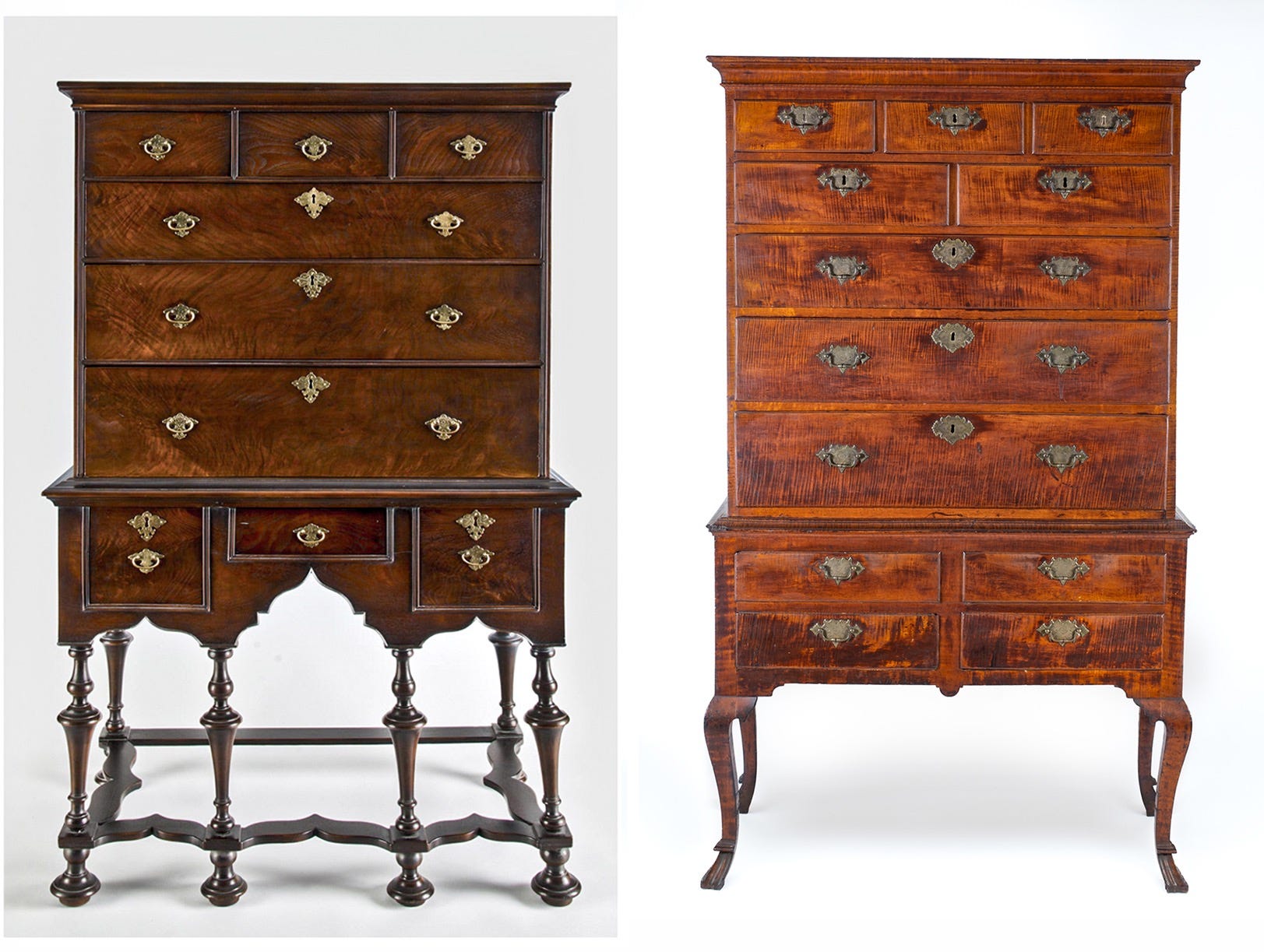
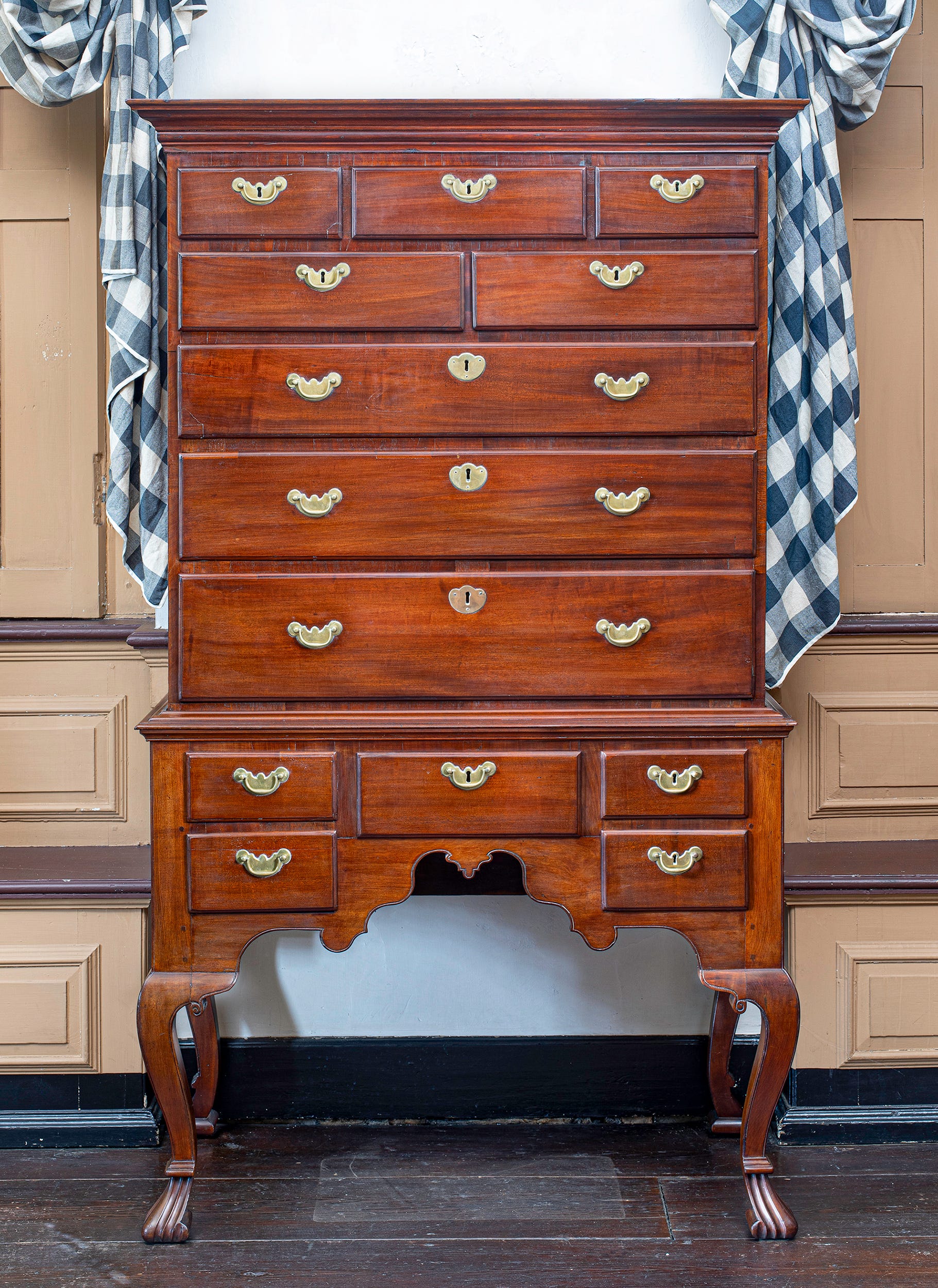
As easy as it is today to examine colonial American furniture from the first half of the eighteenth century, either physically or from images in books or online, it’s easy to forget the dramatic changes that occurred in design and construction in the middle of the 1730s. Rails that divided drawers in case furniture went from 1/2 inch thick, dadoed to the sides, to 3/4 - 7/8 inch thick rails dovetailed or half-dovetailed to the sides, providing a more robust carcase frame work. Cabriole legs replaced turned legs of high chests, dressing tables, and formal chairs. Sides of dressing tables and lower cases of high chests could now be tenoned to the extensions of the legs, doing away with easily damaged turned legs and stretchers whose only junction with the dovetailed box they support are short, round tenons on the top of the legs fit to round mortises in a block of wood glued into the corners of the carcase. Technically, that is not joined construction.
Look at the two high chests in fig. 1. While the high chest on the left was made by John Head in 1726, there is no case furniture attributed to him with third-phase construction before he ceased furniture making in 1745. His high chests of the 1730 would have the same appearance as his chests of the 1720s. The maple chest on the right in fig. 1 was completed in 1738 when James Logan purchased 19 brass handles, 3 escutcheons and 2 suits of drawer locks from the Philadelphia merchant Joseph Paschall.1 It has not a single turned component.
For turners this was a dramatic development. Their work defined the earlier style, but by 1740, cabinetmakers and chair-makers did not necessarily need the services of turners.2
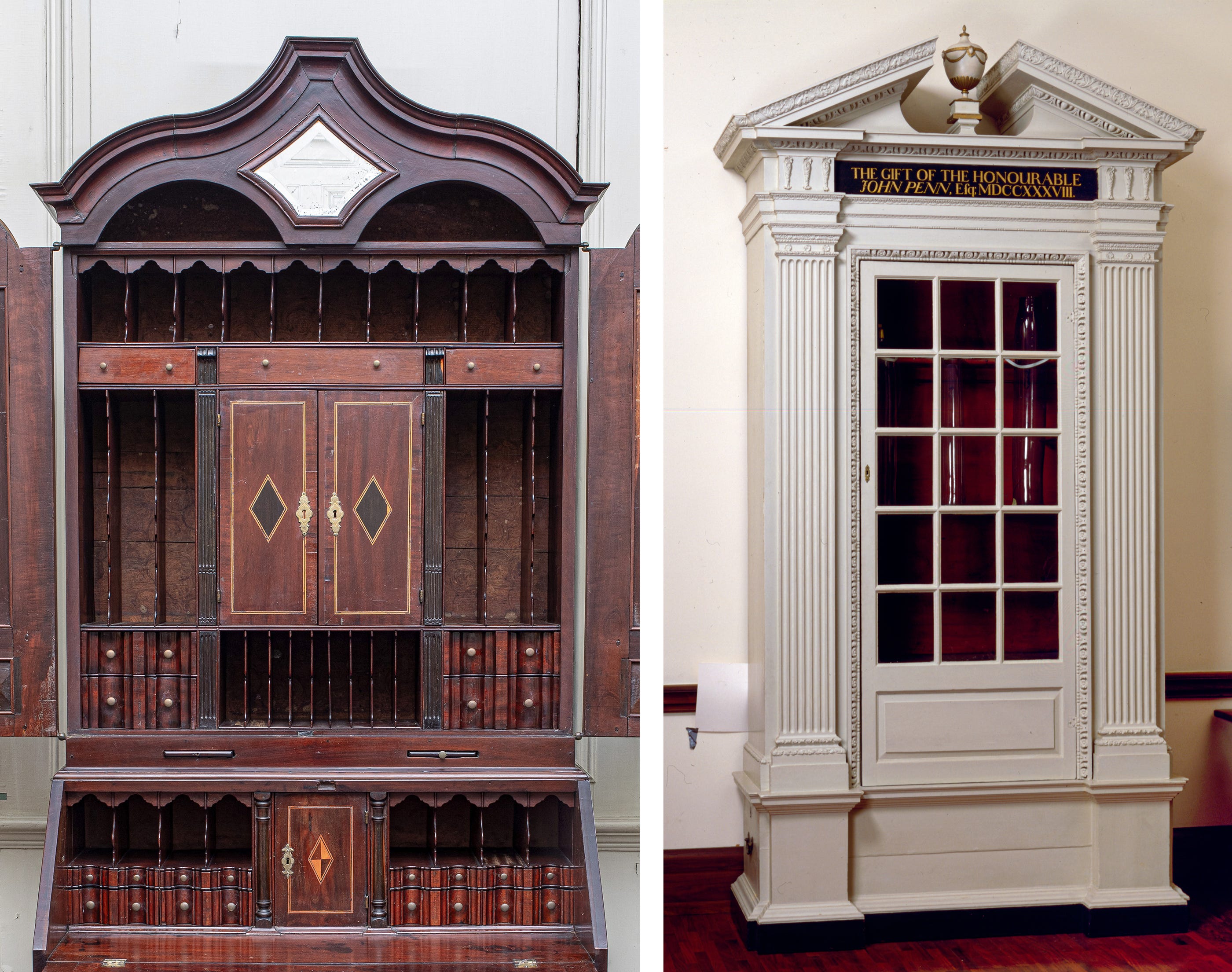
By the late 1730s, arched (triangular) and ogee pediments were first used on Philadelphia case furniture. Derived from English architectural design books, they were at first employed on ceremonial objects and desk and bookcases. Several Philadelphia desk and bookcases with second-phase construction and ogee pediments survive from the 1730s. Elaborate desk and bookcases were expensive, high status objects, the most ornamented and complex objects then produced by cabinetmakers. Made from the finest materials and crafted with great skill and precision, they were symbols of an owners economic achievements and erudition. (fig. 2, left).
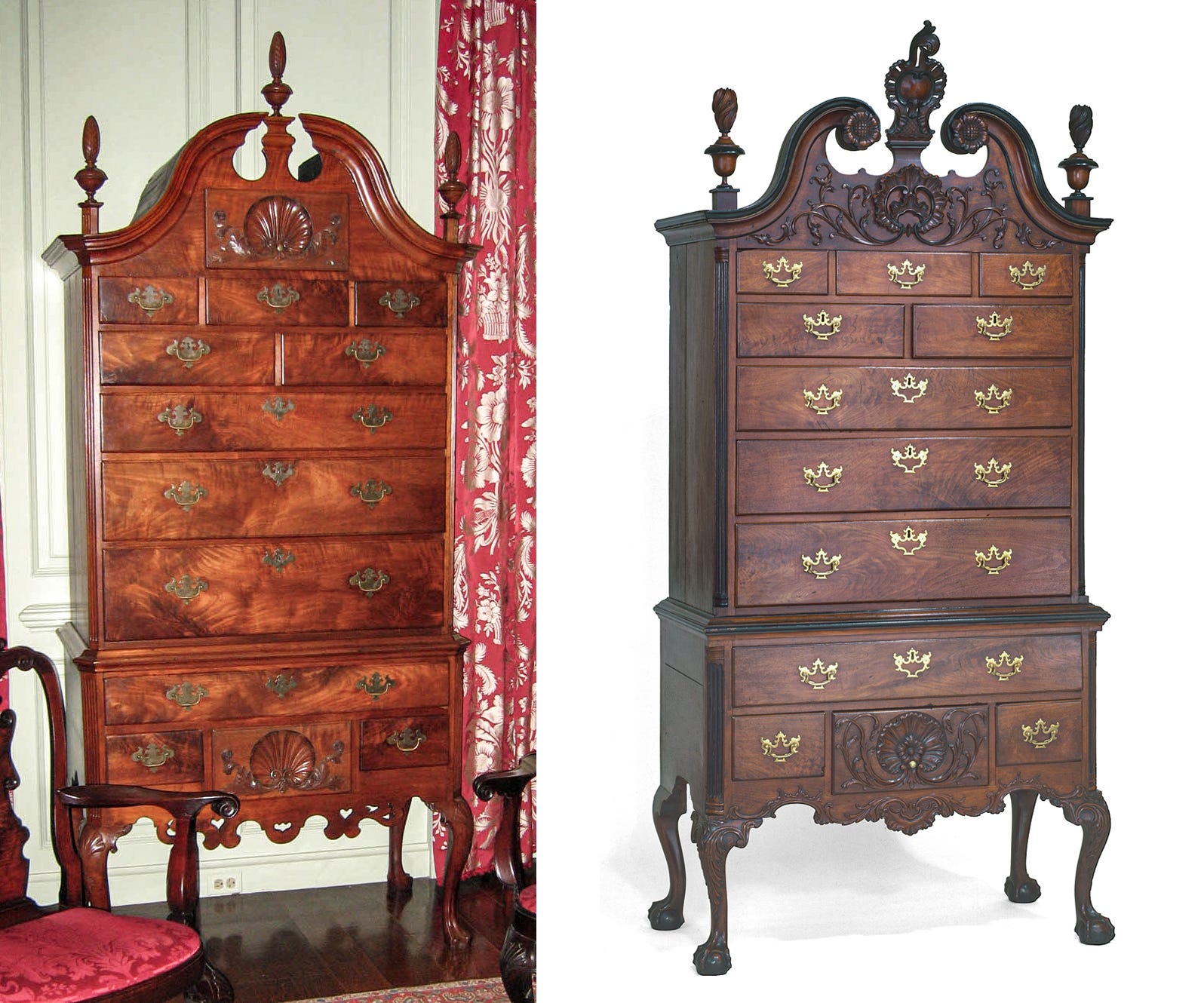
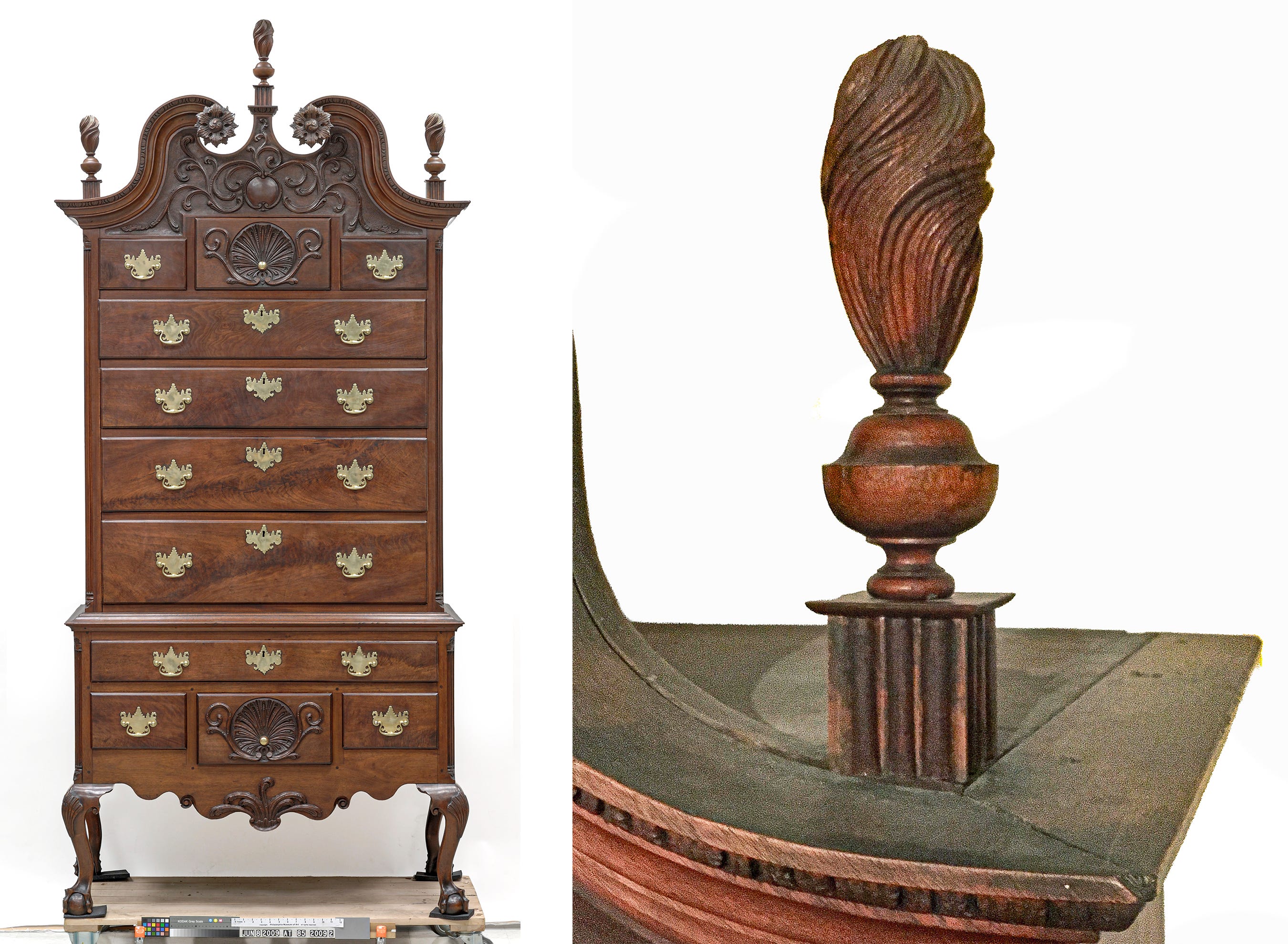
Over the next 30 years, high chests continued to be fashionable in Philadelphia while their popularity receded elsewhere in the Atlantic world. Ogee, scroll, and arched pediments were now styled for high chests. Over time, high chests became a showcase for elaborate ornamental carving (fig. 3).
Turning played a roll, however modest in these new designs. Turned finials, plain or with a carved top component, either three, at the center and sides (fig. 3, left), or two, with a central carved ornament (fig. 3, right), often completed the ornamental design of cornices.
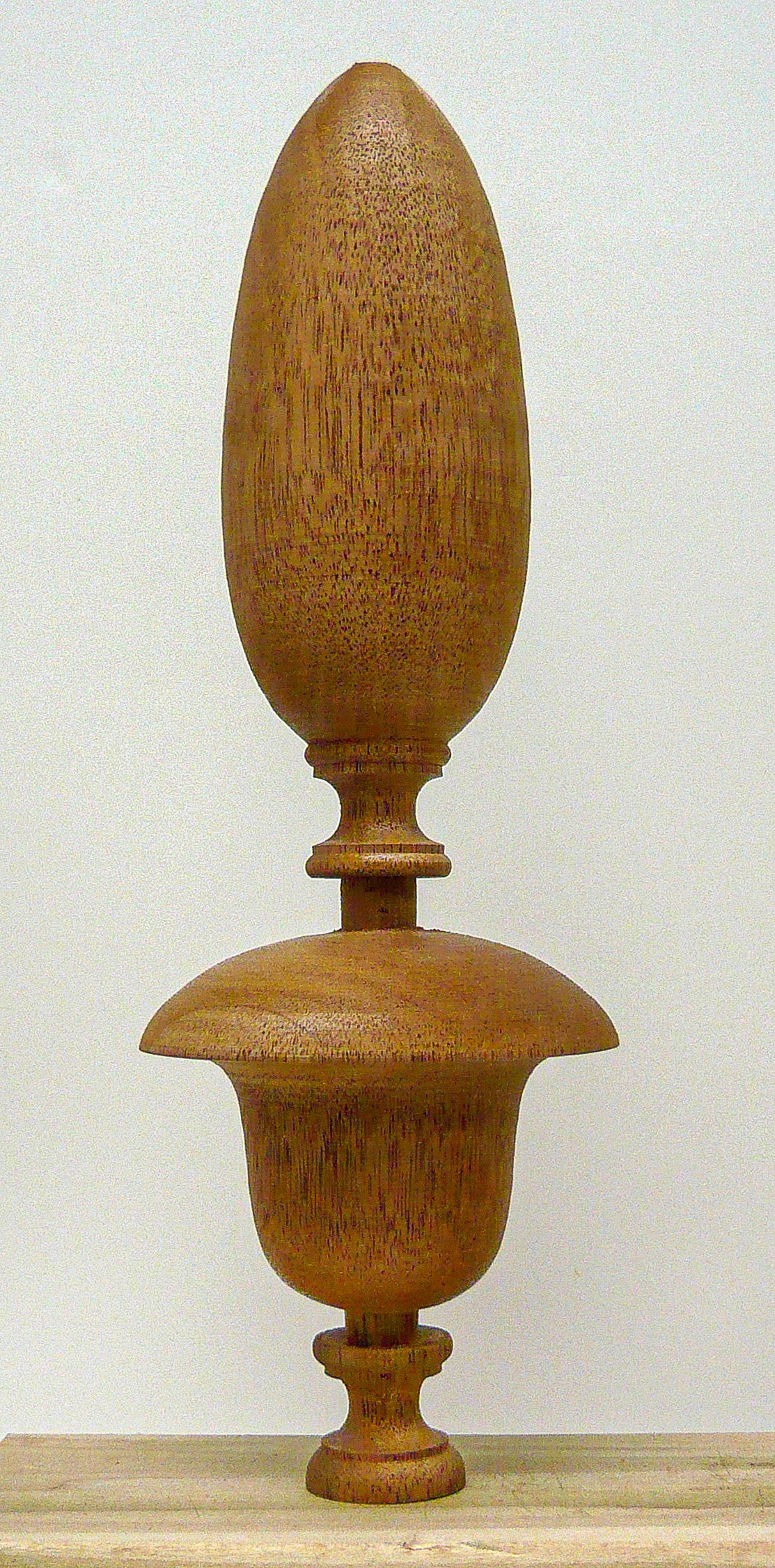
Philadelphia turners employed the same process in creating turned finials they did in making turned legs. Holes are bored through the large urn component, the holes plugged, and the urn turned on the lathe. Upper and lower components are round tenoned to the urn.
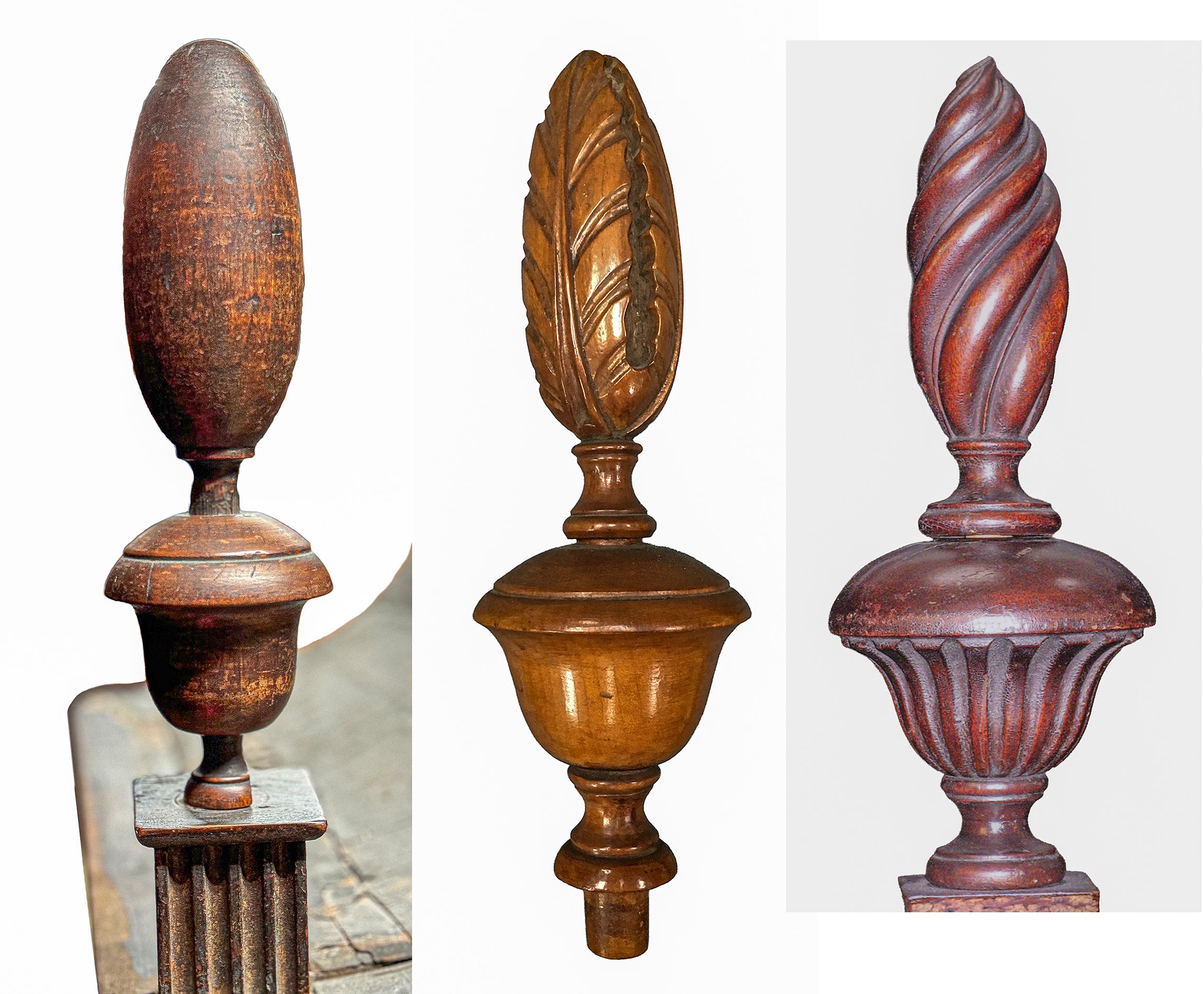
All three finials in fig. 5 are made of three components. Vertical, short grain of the reels adjacent to the round tenons of the upper and lower components often results in damage as the finials are mishandled over time (fig. 5, left). The finials at the center and right in fig. 5 display the first versions of carving designs of the upper components. The three-component design eased carving as the large urn did not interfere with carving tool manipulations (fig. 5, center) and the possibility of the tip of the carving tools damaging contiguous components (fig. 5, right).
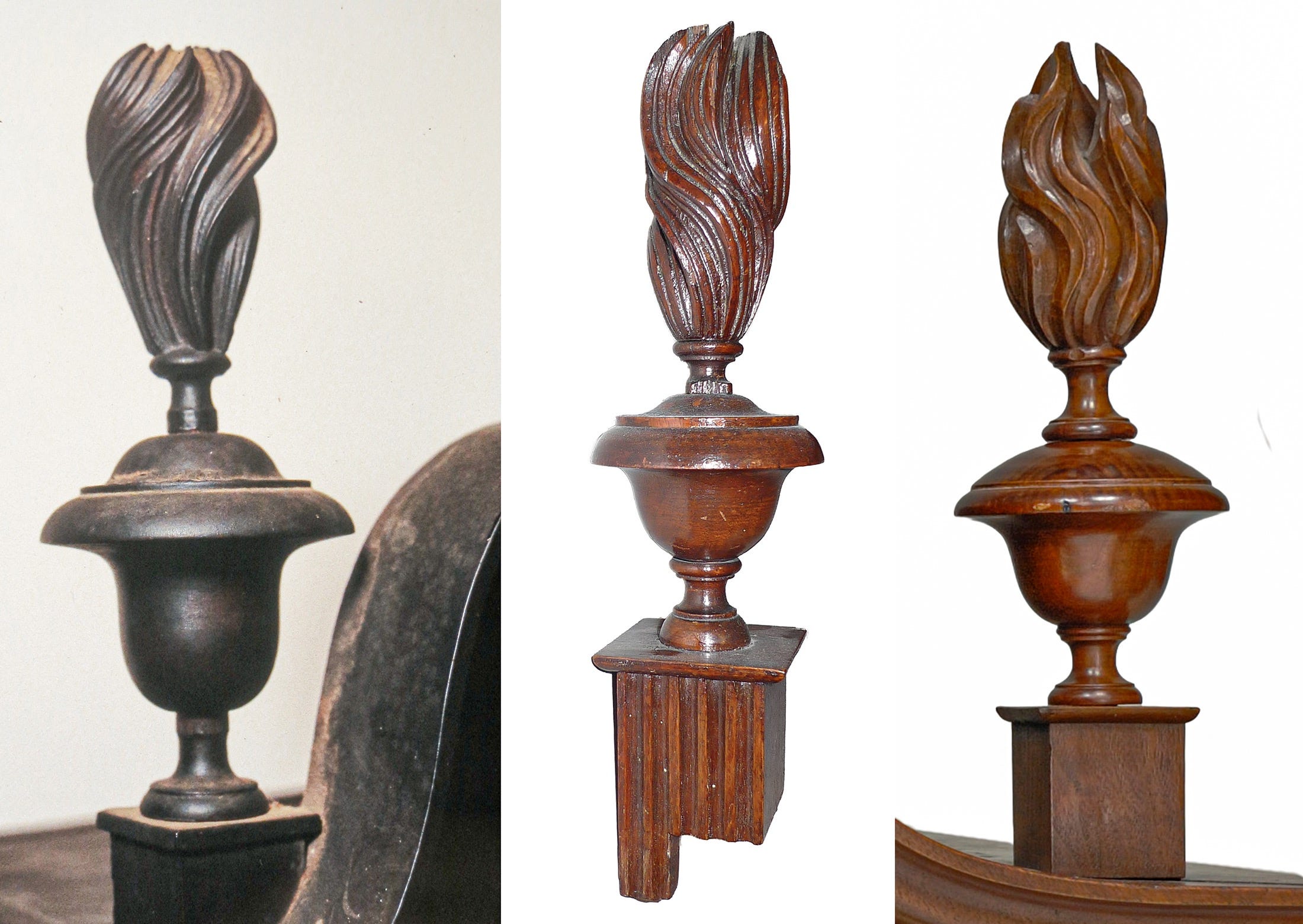
In Philadelphia by the early 1760s, the carved flame finial was fashionable for ornamenting high chests, chest on chests, and clock case pediments. Fig. 6 illustrates three variations. All are made from three components.
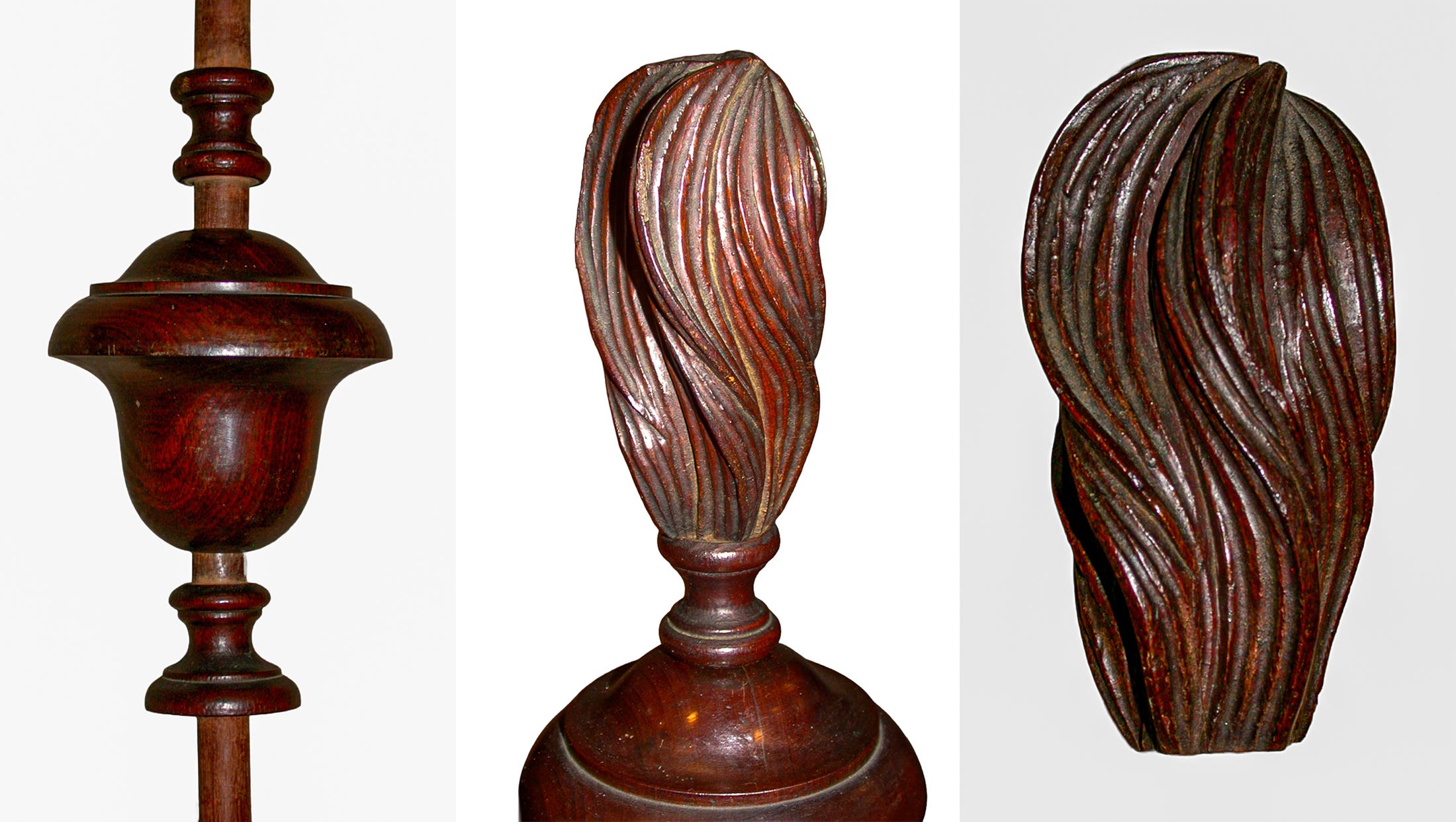
Fig. 6 illustrates an unusual flame finial made of four components. The veiner gouge work could be accomplished with no risk of damage to the bead of the reel beneath it.
Eighty miles west of Philadelphia, a regional school of cabinetmaking flourished in the city of Lancaster, producing round tea tables, desks and bookcases, chest on chests, and high chests influenced by furniture brought by Philadelphia elites to Lancaster beginning in the mid 1750s. However, they did not reproduce Philadelphia craftsmen’s three and four-part finials. All surviving finials adorning Lancaster case furniture were turned and carved from a solid wood blank (fig. 7).
Eight turning tools are included Abraham Whiteall’s (Gloucester, New Jersey, 1720 - Philadelphia 1744) probate inventory, yet the high chest he inscribed with his full name required no turning. Beginning his apprenticeship by 1734, he would have been taught the arts and mysteries of turning along with joinery. Yet by the time of his death, the only turning he might be called on to produce were urn or ball and spire finials for tall case clocks.
Logan stipulated that the brassware and locks be delivered to the cabinetmaker Thomas Stapleford (d. 1739). The number of handles, escutcheons, and locks matches those on the maple high chest (fig. 1, right) and dressing table suite at Stenton listed on James Logan’s 1752 inventory. For discussion of first, second, and third-phase joinery see: Adam Bowett, English Furniture, 1660-1714, From Charles II to Queen Anne. Antique Collectors’ Club, 2002, and Adam Bowett, Early Georgian Furniture, 1715-1740. Antique Collectors’ Club, 2009.
Many joiners in the early eighteenth century were also trained turners. John Head turned the legs of his chests and provided other joiners with turned legs. Many inventories of working joiners from the first three decades of the eighteenth century included lathes, a wheel, and turning tools. See: Jay Robert Stiefel, The Cabinetmaker’s Account, John Head’s Record of Craft & Commerce in Colonial Philadelphia, 1718-1753 American Philosophical Society Press, 2019.